Flea Markets in Berlin: The Complete Guide
Berlin's best flea markets, food markets, and street markets. From Mauerpark to the Turkish Market, your complete guide to the city's outdoor market culture.
Berlin has a thing with markets. Not in the tourist-brochure way, where they get namechecked alongside "vibrant nightlife" and "rich history." More in the way that a city of renters and relics and people who have always had to make do inevitably develops: a culture of things passed along, repurposed, exchanged between strangers on a Sunday morning. Flohmarkt culture is genuinely embedded here.
Every weekend, across every Kiez, somewhere someone is spreading out old record covers on a blanket, arguing pleasantly over the price of a 1970s lamp, or quietly buying a coat that is cooler than anything in any shop window on Kurfürstendamm. You can spend a Saturday visiting three markets and feel like you have covered the entire social spectrum of the city. That is the thing about Berlin's markets. They are not just shopping. They are where the city turns itself inside out.
Berlin has several distinct market types worth knowing. The classic Flohmarkt is the second-hand flea market you picture, piled with vinyl and vintage clothing. The Trödelmarkt is its older, more serious cousin, where professional dealers bring antiques and collectibles. The Wochenmarkt is the neighborhood food and produce market that runs twice weekly in almost every Kiez. And scattered through the calendar you will find design markets, maker markets, and food halls that sit outside all these categories. This guide covers the best of each.
Whether you are a new arrival trying to furnish a flat on a budget, a vinyl obsessive on a permanent hunt, or just someone who wants a reason to be outside on a Sunday, there is a market here that will work for you.
The Big Ones: Berlin's Most Iconic Flea Markets
Flohmarkt im Mauerpark
This is where almost everyone starts. On a Sunday the park fills up from 9am, and by noon the flea market is operating at full social spectacle: live karaoke near the amphitheater, the smell of grilled corn, stalls selling everything from 50-cent paperbacks to legitimately gorgeous vintage furniture at prices that would make Brooklyn cry. The density is what gets you. It is crowded in a way that is somehow still fun, a cross-Berlin crowd of tourists, locals, dealers, and people who just wandered over from the park.
Regulars know to arrive before 10am if they are serious about finding anything. Dealers and scouts clear the good pieces early. If you are coming for the atmosphere, come whenever. If you are coming to actually buy something, come early and bring a bag you do not mind cramming full.
Berliner Trödelmarkt, Straße des 17. Juni
Near Tiergarten, running since 1978, and the longevity shows in the quality of what you will find. This one attracts professional dealers and serious collectors, which means higher prices but also genuinely good pieces. Two sections run in parallel: a proper antique market with furniture, art, ceramics, and jewelry, and a separate craft market with handmade work. It runs every Saturday and Sunday, year-round. If you are looking for something you would actually keep for decades, this is the place to start.
Arkonaplatz
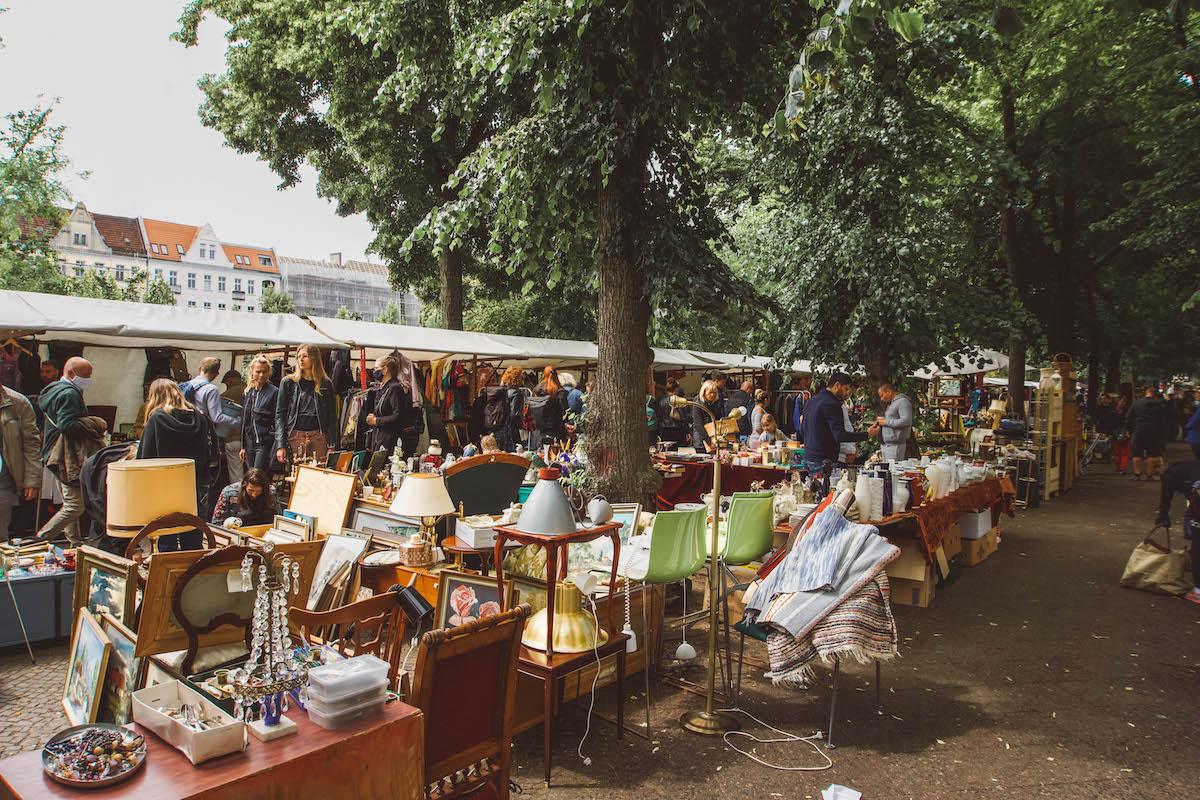
In Mitte, and the one Berlin residents tend to mention when they want to feel slightly smug about having a better market than Mauerpark. Set under old lime trees in a quiet residential square, it runs every Sunday year-round with books, handicrafts, vintage clothing, and small furniture. The atmosphere is unhurried and local in a way the bigger markets are not always. Families with strollers, people with dogs, the occasional serious collector quietly doing their rounds. A good hour or two of browsing without crowd pressure.
Boxhagener Platz
Over in Friedrichshain, runs every Sunday in one of the neighborhood's nicest squares, surrounded by cafes that open early enough to be useful. Smaller than Mauerpark and considerably less touristy, it has a reputation for better deals and a more genuinely local crowd. Consistently good for vinyl, vintage clothing, and the kind of functional homewares that Berlin apartments tend to accumulate. A good reminder that the markets worth returning to week after week are not always the famous ones.
Neighborhood Fleas: Kiez Gems Worth Finding
Not every flea market is trying to be an event. Some of them are just there every Sunday, reliably, because the neighborhood expects them to be. These are the ones that reward familiarity.
RAW Flohmarkt
In Friedrichshain, runs on the same site as several clubs and the broader RAW-Gelände complex, which means the crowd on a Sunday morning sometimes includes people who have not exactly been to sleep yet. That adds a certain texture to the whole thing. The market skews younger and harder to categorize: vintage clothing, vinyl, handmade pieces, design objects, the occasional genuinely weird thing you did not know you needed. It has the underground Kiez energy of the surrounding area without pretending to be anything more than what it is.
Hallenflohmarkt Treptow
Berlin's answer to the problem of November. It runs year-round, indoors, in a large covered hall in Treptow, every Sunday regardless of weather. For a city that is grey from October to March, this matters more than people tend to acknowledge. The selection covers antiques, collectibles, and general flea market finds. It will not give you the atmosphere of an outdoor market in April sun, but it will reliably give you something to do on a rainy Sunday when everyone else is weighing Netflix against existential dread.
Rathaus Schöneberg
Runs Saturday and Sunday in front of the district's town hall, the same building where JFK delivered the Ich bin ein Berliner speech in 1963. The market is reliably local: books, clothing, household goods, bits of Berlin life for sale at reasonable prices. Good as a secondary market if you are already in Schöneberg.
Fehrbelliner Platz
Directly outside the U-Bahn station in Wilmersdorf, runs both days with a dedicated art mile running alongside the standard flea market stalls. Painters, ceramicists, jewelry makers, and woodworkers sell their own work rather than second-hand finds, which gives the market a different character. If you tend to accidentally come home from flea markets with original art, this is where that tends to happen.
Ostbahnhof Antique Market
Runs every Sunday just outside the station in Friedrichshain and operates at the more professional end of the spectrum. Stamps, coins, antiquarian books, postcards, records, porcelain, vintage furniture from dealers who know exactly what they have and price accordingly. Worth an hour if you are serious about any of those categories.
Bode Museum Antique and Book Market
Runs every weekend near Museum Island against one of the most beautiful backdrops in the city. Rare books, antiquarian pieces, art, and small antiques along the Spree. More of a specialist destination, but the setting alone makes it worth a detour if you are in Mitte.
Beyond Vintage: Design Markets and Makers
Nowkoelln Flowmarkt
Runs every second Sunday at Maybachufer in Neukölln and operates on a different premise from the standard flea market. It is a showcase for Berlin designers, independent labels, and makers who want a direct-to-customer format. Handmade jewelry, printed clothing, vintage finds, vinyl records, street food, sometimes live music or performance. It started as an explicit alternative to the second-hand market format and has maintained that distinction. The vibe is distinctly Neukölln: creative, international, slightly chaotic in a good way. Because it runs every second Sunday rather than weekly, checking the schedule before you go is worth the thirty seconds. On Traube it's all on one page — the Flowmarkt, the Tuesday/Friday market, the Saturday Stoffmarkt. Same canal, completely different things.
There are also seasonal and popup design markets that circulate through the city, particularly in spring and autumn, turning up at Kulturbrauerei, Tempelhof, and various larger open spaces. They tend not to run on fixed weekly schedules, which makes them harder to plan for. Checking Traube is the most reliable way to catch them when they appear.
Food, Fresh Produce, and Market Halls
No guide to Berlin's market culture makes sense without the food markets. They serve a different need from flea markets but share the same outdoor, direct, come-in-person character. And several of them have become city institutions in ways that transcend the purely practical.
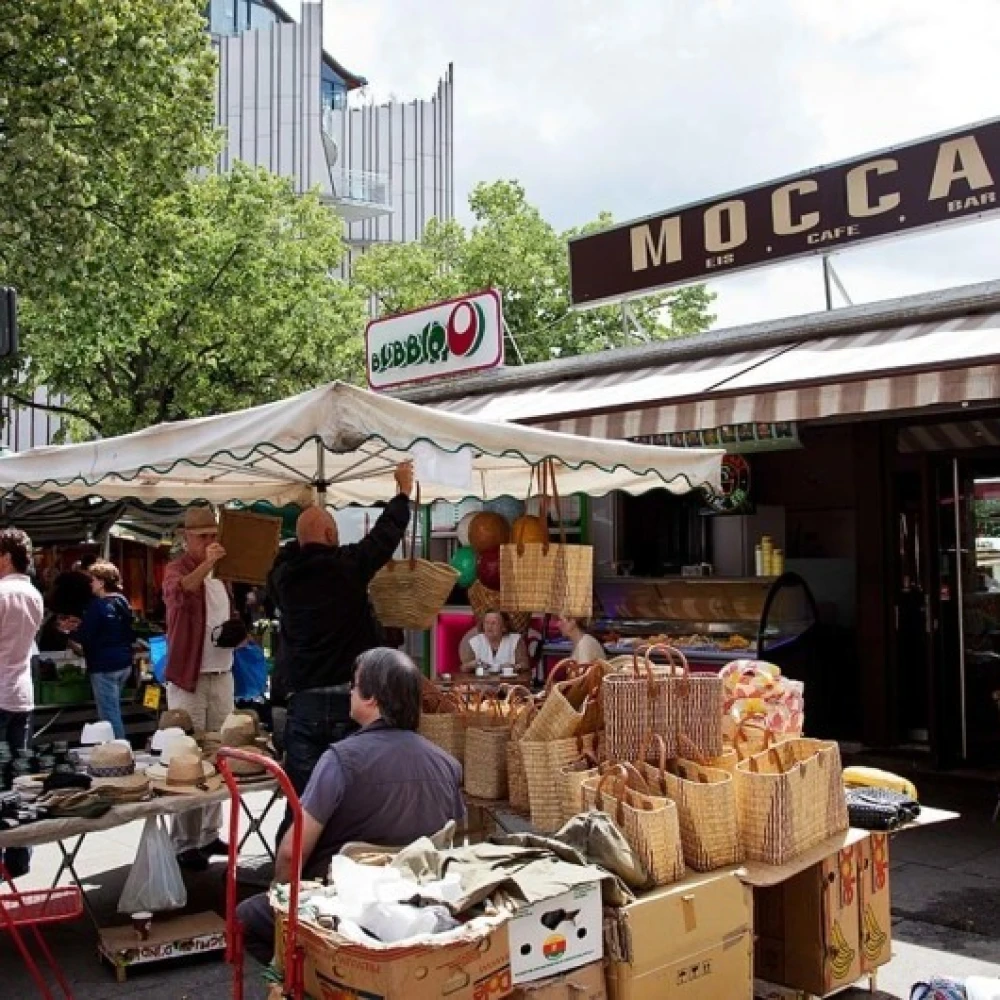
Turkish Market at Maybachufer
Everyone calls it the Turkish Market. The official name is Wochenmarkt am Maybachufer, which almost nobody actually uses. It has run along the Landwehr Canal every Tuesday and Friday since the early 1970s. The canal bank fills with produce, spices, olives, cheese from across the Mediterranean, textiles, bread from ovens that arrive on trailers. The crowd is genuinely mixed in a way that reflects the neighborhood's particular history, and the energy on a warm Friday afternoon is unmatched anywhere in the city. Arrive before 1pm for the best selection. Bring a bag, or two. Prepare to spend more on food than you planned.
Markthalle Neun
In Kreuzberg, operates from a restored nineteenth-century market hall and has become one of the most significant food destinations in the city. Permanent vendors run alongside weekly events, most notably Streetfood Thursday every Thursday evening, which draws a large crowd and a rotating lineup of vendors from Berlin's independent food scene. The building itself is worth visiting. The food gives you a reason to return.
Wochenmärkte
Beyond these anchors, Berlin's weekly food markets are worth finding in your own neighborhood. Almost every Kiez runs one, typically twice a week, often at a local square or along a canal. These are not tourist destinations. They are where residents actually buy vegetables, flowers, and eggs from producers they recognize by name. Which is, in a certain way, the whole point.
How to Do a Berlin Flea Market Right
Bring cash. Most market stalls do not take cards. Those that do often add a surcharge. Have euros, and have small bills. A mix of fives and tens makes transactions much smoother, especially when haggling.
Time it right. For serious buying, go early. Dealers and scouts arrive when markets open and clear the good pieces first. If you are coming to browse and enjoy the atmosphere, come whenever. A contrarian approach: arrive an hour before close, when vendors are more motivated to deal rather than pack things back up.
Haggling is normal and expected at flea markets, but it is not aggressive by default. Express genuine interest, ask if they would take a bit less, accept a small reduction, say thank you, move on. Nobody is expecting a dramatic negotiation. If a price seems genuinely unfair, it is entirely fine to walk away. At design markets and food markets, haggling is less expected and generally not appropriate.
Weather matters, but not as much as you think. Most outdoor markets run in all but the most extreme weather. Bad weather reduces both vendors and crowds, which can actually work in a buyer's favor: the committed sellers stay regardless, and the competition for good pieces is lighter. The Hallenflohmarkt Treptow is your weather-proof option.
Seasonality is real. March through October is the peak window for Berlin's outdoor market scene. Markets still run in winter, but spring and summer are when Mauerpark is genuinely packed, when the canal markets are fully alive, and when the seasonal design markets start appearing on the calendar.
Frequently Asked Questions
What day are most flea markets in Berlin?
Sunday is Berlin's primary flea market day. Mauerpark, Boxhagener Platz, Arkonaplatz, RAW Flohmarkt, Hallenflohmarkt Treptow, and Ostbahnhof Antique Market all run on Sundays. The Berliner Trödelmarkt on Straße des 17. Juni, Rathaus Schöneberg, and Fehrbelliner Platz run both Saturday and Sunday.
What is the biggest flea market in Berlin?
Mauerpark is the most well-known and typically the most crowded. The Berliner Trödelmarkt on Straße des 17. Juni is larger in footprint and more focused on antiques and higher-quality collectibles.
Do Berlin flea markets accept card payments?
Most do not. Bring cash (euros) to any Berlin flea market. Small bills make transactions easier and speed up haggling.
Is the Wochenmarkt am Maybachufer (Turkish Market) open every day?
Tuesdays and Fridays only. Maybachufer in Neukölln, roughly 11am to 6:30pm. Vendors start packing around 6, so get there before that.
What are Berlin flea markets good for buying?
Berlin markets are consistently good for vinyl records, vintage clothing (especially 70s and 80s pieces), DDR-era objects, mid-century German furniture, old German books, cameras, and ceramics. Quality and prices vary significantly between markets and between individual vendors.
Is there an indoor flea market in Berlin?
Yes. The Hallenflohmarkt Treptow runs every Sunday indoors, year-round, regardless of weather. It is the most reliable option in winter or on rainy days.
What does Flohmarkt mean?
Flohmarkt translates directly as flea market. The word comes from the French marché aux puces and shares the same origin story: the theory that second-hand bedding and furniture might harbor the occasional flea. Trödelmarkt (junk or antique market) is another common term for the more antique-focused version. Wochenmarkt refers to a weekly food and produce market.
The best thing about Berlin's market culture is that it is not going anywhere. Mauerpark was doing this before gentrification made Prenzlauer Berg expensive. The Turkish Market has been on the canal since before half its current visitors were born. The Berliner Trödelmarkt has been on Straße des 17. Juni since 1978. There is a permanence to these things that the rest of the city's cultural scene does not always have. You can come back every Sunday for years and the market will still be there.
See you out there.